Inside the home of Joseph Pell Lombardi
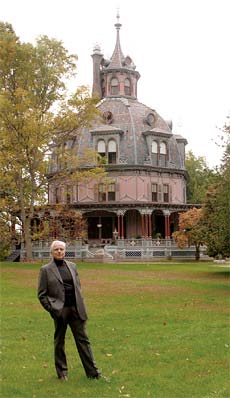
Architect Joseph Pell Lombardi in front of the Octagon House.
By Marc Ferris
During the week, architect Joseph Pell Lombardi helms a 20-person firm
in Manhattan that has specialized in historic conversion projects for
almost 40 years. On weekends, he does the same thing with his own
homes.
Lombardi's passion for restoring noteworthy historic structures dominates his free time: In the 1970s, he transformed the wood-paneled offices of Sinclair Oil Corporation titan Harry Sinclair into a sumptuous residence at 33 Liberty Street in Downtown Manhattan, his residence during the week. And every weekend for the last 30 years, he has presided over a painstaking preservation project in Irvington, N.Y., which saved the stunning Octagon House, a 148-year-old residence topped with an octagonal observatory, from almost certain demolition. Though almost finished with the first phase of the restoration, save for the basement and a portion of the elaborate veranda, the home requires constant maintenance. "It's like a suspension bridge," said Lombardi. "Once you reach the end, you have to go back to the beginning and start again." Taking his passion to obsession status, he's also restoring a Vermont farmhouse, a chateau in France and a Hungarian castle. The complicated work on the Octagon House occupies most of his weekends, though he regularly visits his three other homes on roughly six-week cycles. When he bought the house from the National Trust for Historic Preservation for $75,000 in 1978, the slate-covered dome had begun to collapse, threatening the home's structural integrity. Lombardi fixed the roof and began restoring the house to the way it looked in the 1870s, down to the garden, artwork, period furniture and quirky shades of paint inside and out. Lombardi pursued one particular antique bedroom set for years because it depicts Hudson River scenes, and the bedposts are octagonal. An icon in Irvington, a town filled with grand architecture built by 19th-century captains of industry, the Octagon House is the only known residence in the world built in the domed colonnaded shape of a Roman temple, Lombardi said. Banker Paul Armour built the first two floors in 1860, establishing the eight-sided footprint. Tea merchant Joseph Stiner added the dome and the wraparound veranda in 1872. The house resembles a Technicolor version of the U.S. Capitol dome or the top of a Roman cathedral, and seems incomplete, as if the rest of the building were buried below the ground. Visitors have referred to the home as a "baroque spaceship" and "an arrested carousel," said Lombardi. Inside, the house appears pristine. Wood paneling covers the circular room inside the dome. A spiral staircase leads to the octagonal observatory, which provides 360-degree views of the Hudson River Valley. Like previous residents, Lombardi reports several ghost sightings. He once hosted an event for a nonprofit organization and insists that he saw a woman in a flowing bright white dress wander through the house, then disappear. "It's not a ghost intent on malice, so I'm OK with it," he said. Preservation for 'oddballs' Lombardi, 68, grew up in Manhattan, then spent his teen years in Irvington, where he graduated high school and knew about the Octagon House, though he never aspired to own it. He launched his Manhattan firm in 1969, when most architects were attempting to make their mark with bold modernist statements. "Everyone else wanted to do skyscrapers, and I was just about the only firm that specialized in the historic preservation field," he said. "I was considered to be an oddball, but now you have historic preservation majors at universities. There was almost none of that back then." He began refurbishing townhouses in Murray Hill and Kips Bay and invested in local properties. During the depressed early 1970s, he bought 239 East 31st Street for $30,000 with $5,000 down, and bought five more townhouses on East 32nd Street. A pattern emerged: After he began renovating his assets, buyers came along who then hired him to continue renovations. "You had these gorgeous one-family brownstones that had been turned into rooming houses, but the additions were easily reversible, and it didn't take too much work to restore their grandeur," he said. In the 1970s, when the city's zoning changed to accommodate lofts in manufacturing zones, he jumped at the chance to buy and sell what were then referred to as raw-space conversions, including his first such project at 18th Street and Broadway. Lombardi provided heat, electricity and plumbing, but tenants bought "as is," often without walls and other finishes. "The term 'loft' as we know it now didn't exist, and the banks wanted no part of these arrangements," he said. But the market snowballed. He found work in Noho, Soho and the Flatiron district and began arguing zoning variance cases in front of the Board of Standards and Appeals, a task usually done by lawyers, although the board consisted of architects and engineers. In the late 1970s, a friend told him that 33 Liberty Street, a 1919 office tower that had served as headquarters of Sinclair Oil, was on the block. At the time, almost no one lived in Downtown Manhattan, yet Lombardi sold out half the building. When he went to the flagship Chase Manhattan Bank branch across the street seeking a loan to finance the rest of the building, the loan officer hustled him out. Before leaving, Lombardi asked the banker to consider the words of Chase chairman David Rockefeller, who had recently been quoted saying that Downtown needed residents to become a viable community. "I implored him to bring the deal to Rockefeller, but he scoffed. A few weeks later, I got a call from the same loan officer seeking a meeting, and he ushered me in as if the first incident had never happened." Lombardi received a $1 million mortgage with a quarter down in cash. He moved into the building's 29th floor after converting Harry Sinclair's large office into an apartment. Not counting his five homes, Lombardi has completed around 160 loft conversions, about a third of them as principal, and is working on the former Dia museum building at 550 West 22nd Street. The upper floors will consist of residences, and galleries will occupy the rest. He's done around 15 buildings on Greene Street and is now working on numbers 70, 96, 98 and 102, along with four Upper East Side mansions. But the economic climate, which he said reminds him of lean times like the early 1970s, the late 1980s and after Sept. 11, may slow him down. "After Sept. 11, clients didn't pay, and financing was tough to secure," he said. "Now, I'm scared stiff that there will be fewer phone calls, and I'll have to wonder where my next clients will come from." Despite all the deals Lombardi has undertaken, he's "not sipping mint juleps on the porch" of the Octagon House, he said. "I have a hammock I've never ever been in. There are many times when I've had $5,000 that I spent restoring part of the house rather than go out for a night on the town."
|