|
|
Volume 21, Number 40 | The Newspaper of Lower Manhattan | February 13 - 19, 2009
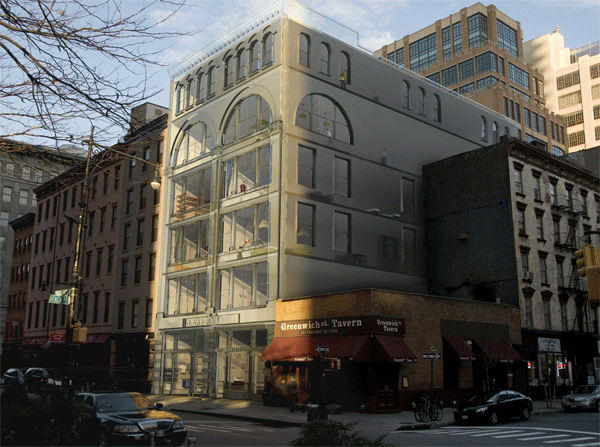
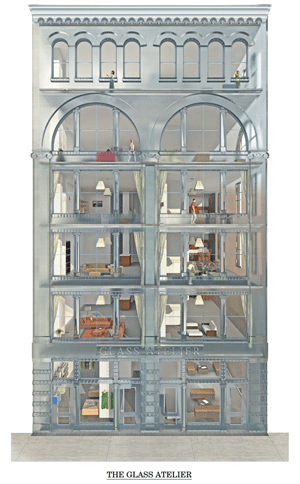
Renderings of Joseph Pell Lombardi’s design for a glass apartment building for 401-403 Greenwich St. The bricks will be made of glass and held together with mortar. Lombardi is working with Owens Corning on the glass engineering.
By Julie Shapiro Joseph Pell Lombardi’s design for a new six-story building in Tribeca has all the hallmarks of the historic neighborhood: brick arches, tall windows and fine detailing on the cornice and storefront. But unlike the neighborhood’s centuries-old buildings, the new building Lombardi designed for 401-403 Greenwich St. will be made entirely of glass. That means glass bricks stacked to form the facade; glass bricks fanned to form arches; glass columns dividing glass windows; stippled glass trim; and even glass doorknobs. “We want you to see through it, to see structurally how it all works,” Lombardi told Community Board 1’s Landmarks Committee Thursday night. Lombardi designed the building between Hubert and Beach Sts. for a British developer he declined to name. The Glass Atelier, as Lombardi calls it, will offer a clear view not only of the building’s structure but also of its occupants. “If I want privacy…I would pull the drapes,” Lombardi said. The project is not a sure thing yet, as Lombardi needs the approval of the city Landmarks Preservation Commission, because he plans to demolish a building in the Tribeca West Historic District. Lombardi presented his plan to C.B. 1’s Landmarks Committee this week, seeking their advisory approval. The committee was split on the project, concerned about everything from the modern design to the practicality of building with glass. “I’m nervous,” said Roger Byrom, chairperson of the committee. “Are there other examples where people have built in this form, Joe, so we know that the doors are going to hang and the windows are going to open?” “As far as we can do in our research,” Lombardi replied, “it is unique unto the world.” Lombardi worked with engineers at Owens Corning for six months to figure out how the building will, as Byrom put it, “stick together.” The building will be made of steel beams, which along with the mechanicals will be coated in concrete so as to appear ghost-like behind the glass exterior. A thin layer of mortar, lightly tinted blue, will join the solid glass bricks. Even the window sashes and frames will be a transparent acrylic, while the sides of the building will be a frosted glass.
The project’s English developer intends to put two retail stores on the ground floor and eight rental apartments above, but the building may house all offices at first because new residential units are not allowed in northern Tribeca. The city is looking rezone the neighborhood to allow residential uses as of right. If the rezoning falls through or takes too long, Lombardi may apply for a variance. Lombardi hopes to begin construction this summer and finish a year later. He would not give a price tag but said, “There’s no question the financing is there.” While condo prices have fallen, Lombardi pointed out that Manhattan’s rental market has stayed steadier, indicating the project’s viability. The unnamed English developer, 102 Green Street L.L.C., is working with Lombardi on two other projects: Converting the former Dia Museum on W. 22nd St. into a nonprofit display space called COG, and restoring a landmarked building at 102 Greene St. that was heavily damaged in a 1950s fire. The site where Lombardi wants to build his Glass Atelier currently houses a recent six-story loft building at 401 Greenwich, which he would strip to its steel beams and mechanicals, and an older two-story building at 403 Greenwich that he would demolish. The older building was built as a four-story row house in the 19th century, then reduced to a two-story building with a loading dock in 1947. In the 1960s, the building changed again, with the loading dock replaced by a glass storefront. Lombardi has developed and designed many historic restorations in Tribeca including the Mohawk Atelier at Hudson and Duane Sts. Members of C.B. 1’s Landmarks Committee disagreed over whether 403 Greenwich St. is worth preserving. “[It] is not something I think should be easily torn down,” said Bruce Ehrmann, co-chairperson of the committee. “It is not a completely incontextual building.” Michael Connolly, a committee member, said the building was not historically significant. “In fact, I think it’s worth tearing it down and putting something else up — it’s just a question of what,” Connolly said. Connolly liked the design of the new glass building, which looks a bit like a sparkling ice sculpture, but others were less enthusiastic. “I see a really thin line between really artistic and really cute, and I’m not quite sure where it fits in,” said Brian Lutz, a public member. “I’m not quite sure I’m ready to see an all-glass building in Tribeca.” Ehrmann, the committee co-chairperson, called the design clever, but he had a deeper “socio-aesthetic” concern, which he admitted went beyond the committee’s purview. The concern, he said, is “the notion of an all-glass building…with people totally visible inside and out and everyone looking in and everyone looking out, while a whole raft of homeless people are on the street in a depression. I find it rather 2007 for the current era.” In the committee’s final vote, two people were against the project, one was for it and one abstained. Lombardi, speaking by phone after the meeting, said the all-glass structure isn’t as luxuriously expensive as it might sound. Glass bricks and columns are not much more expensive than their quotidian counterparts, and while the extra engineering costs more, it doesn’t cost anywhere near as much as the custom curtain walls at other new buildings in the city. Glass bricks also have a higher fire rating and better sound insulation than glass curtain walls, he said. “I don’t really see that homeless bankers from the recession would be in a turmoil because they saw a beautiful building,” Lombardi said. Lombardi will present the design at Community Board 1’s full board meeting Feb. 24 and at the Landmarks Preservation Commission March 3. Julie@DowntownExpress.com |
|
|
Wirtten permission of the publisher must be obtained before any of the contents of this newspaper, in whole or in part, can be reproduced. |
 Bricks made of glass will build these Tribeca homes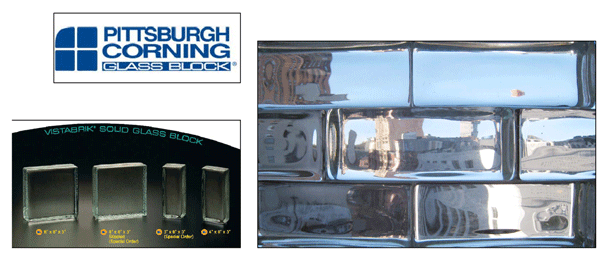






 |
 |
 |
 |
 |